John Donne · Chaucer · Shakespeare

The Canonization

A poem small enough to fit in the hand.
A universe too large to stay there.

Enter Donne’s lyric as a constellation of remembered texts—bird parliament, plague token, phoenix flame, golden urn, speaking monument, and the whole world contracted into two eyes.

Scroll to move through the poem

Not a hunt for matching words.

The strongest evidence is architectural: unusual words, images, and arguments recur together. Every parallel below is graded so resemblance never masquerades as proof.

Strong

Several unusual correspondences form one coherent system.

Moderate

A meaningful cluster exists, but the route remains uncertain.

Contextual

The passage explains available language, not direct borrowing.

Weak

A useful control with a high risk of coincidence.

Illuminate

Stanza 1 of 5

Silence the world

The lover yields office, wealth, court, king, and coin—on one condition: let private love remain unpoliced.

command to silencepublic advancementprivate love
John DonnePoems, 1633
  1. 1FOr Godsake hold your tongue, and let me love,
  2. 2Or chide my palsie, or my gout,
  3. 3My five gray haires, or ruin’d fortune flout,
  4. 4With wealth your state, your minde with Arts improve
  5. 5Take you a course, get you a place,
  6. 6Observe his honour, or his grace,
  7. 7Or the Kings reall, or his stamped face
  8. 8Contemplate, what you will, approve,
  9. 9So you will let me love.
Read the 1633 text
chaucermoderate

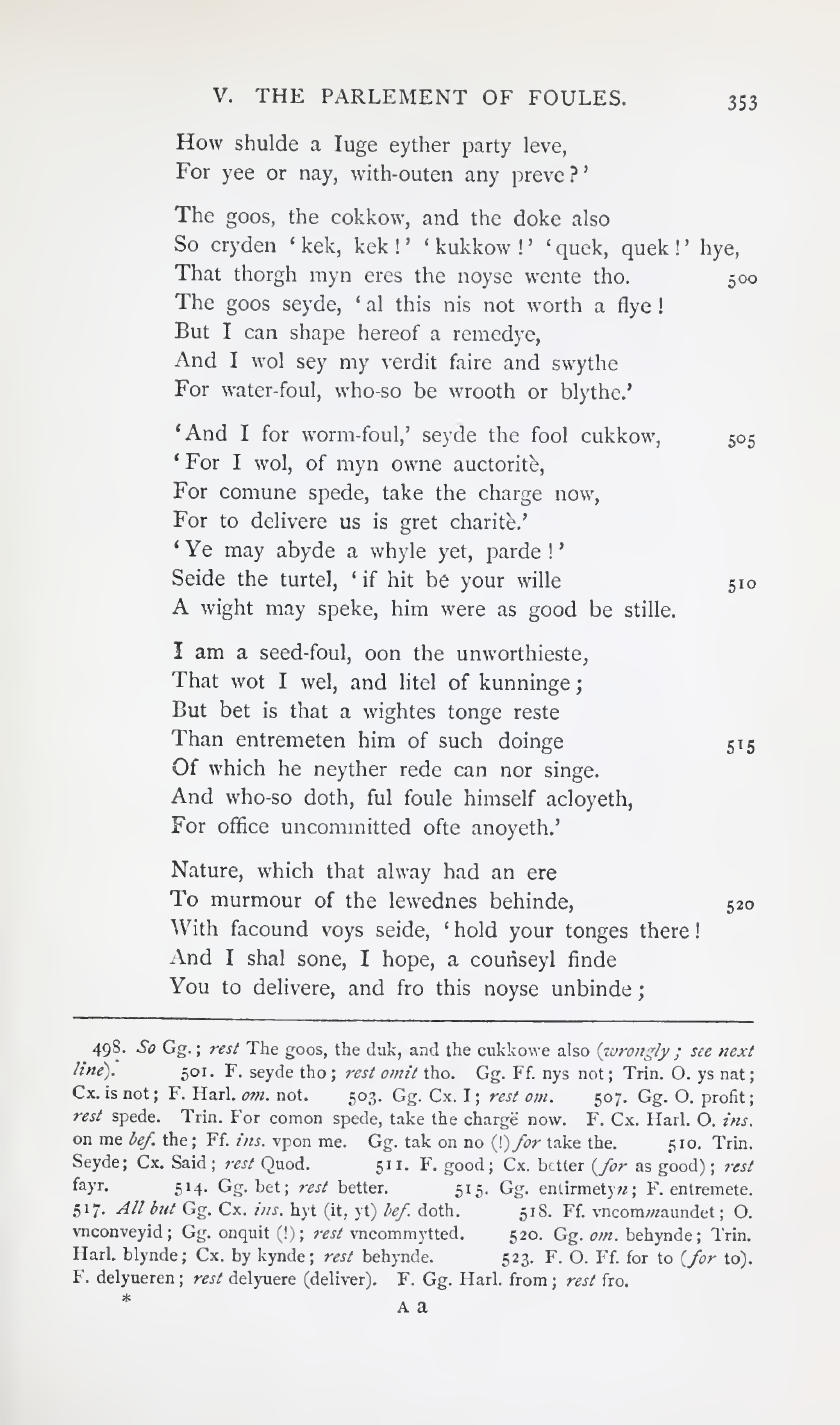
Parlement of Fouleslines 519–525

Nature, which that alway had an ereTo murmour of the lewednes behinde,With facound voys seide, ‘hold your tonges there!And I shal sone, I hope, a counseyl findeYou to delivere, and fro this noyse unbinde;’

The phrase alone is common. Its force is architectural: Chaucer silences a noisy bird tribunal, and Donne later activates its fly, eagle, dove, phoenix, sex, and mate-choice system.

View public source Skeat, vol. 1, p. 353
shakespeareweak

Hamlet3.2

HAMLETThey are coming to the play. I must be idle.Get you a place.

An exact phrase but a deliberate negative control: functional, common, and unsupported by a larger cluster.

View public source Folger Shakespeare
SourceShared operationDonne’s transformation

“hold your tonges”

silence

“hold your tongue”

unsolicited office annoys

social pressure

course · place · honour · grace

bird tribunal

frame activated later

private lovers

Walter Skeat’s edition of Chaucer’s Parlement of Foules, page 353, showing the noisy bird debate and Nature’s command to hold their tongues.
Primary-page control

The noisy parliament: Chaucer’s birds debate, interrupt, and are ordered to silence.

Open the public scan

Stanza 2 of 5

Audit the damage

Petrarchan weather is forced through civic accounting: no ship sinks, no field floods, no death enters the plague bill.

heat, plague, mortalitylove under audit
John DonnePoems, 1633
  1. 10Alas, alas, who’s injur’d by my love?
  2. 11What merchants ships have my sighs drown’d?
  3. 12Who saies my teares have overflow’d his ground?
  4. 13When did my colds a forward spring remove?
  5. 14When did the heats which my veines fill
  6. 15Adde one more to the plaguie Bill?
  7. 16Soldiers finde warres, and Lawyers finde out still
  8. 17Litigious men, which quarrels move,
  9. 18Though she and I do love.
Read the 1633 text
shakespearestrong

Troilus and Cressida2.3

ULYSSESHolds in his blood such swoll’n and hot discourseThat ’twixt his mental and his active partsKingdomed Achilles in commotion ragesAnd batters down himself. What should I say?He is so plaguy proud that the death-tokens of itCry “No recovery.”

A rare word is embedded in a coherent plague cluster: bodily heat, ‘plaguy’ pride, and fatal death-tokens. Donne turns those signs into the numerical register of the bill of mortality.

View public source Folger Shakespeare
Word historystrong

The two-node test1609 quarto

plaguy → death-tokenscanonize us → future fameone Shakespeare play, two rare nodes

Troilus and Cressida also contains the canonization formula used in stanza 4. The paired relation is materially stronger than either word considered alone.

View public source EarlyPrint A12021
SourceShared operationDonne’s transformation

hot discourse in the blood

bodily heat

heats which my veines fill

plaguy proud

rare adjective

plaguie Bill

death-tokens

mortality recorded

one more to the Bill

Stanza 3 of 5

Become the riddle

Species, sex, flame, and number collapse: fly, tapers, eagle, dove, phoenix—two lovers made one mysterious thing.

avian identitiestwo-in-one / both sexesflame, death, renewal
John DonnePoems, 1633
  1. 19Call us what you will, wee are made such by love;
  2. 20Call her one, mee another flye,
  3. 21We’are Tapers too, and at our owne cost die,
  4. 22And wee in us finde the’Eagle and the dove,
  5. 23The Phoenix ridle hath more wit
  6. 24By us, we two being one, are it.
  7. 25So, to one neutrall thing both sexes fit.
  8. 26Wee dye and rise the same, and prove
  9. 27Mysterious by this love.
Read the 1633 text
chaucerstrong

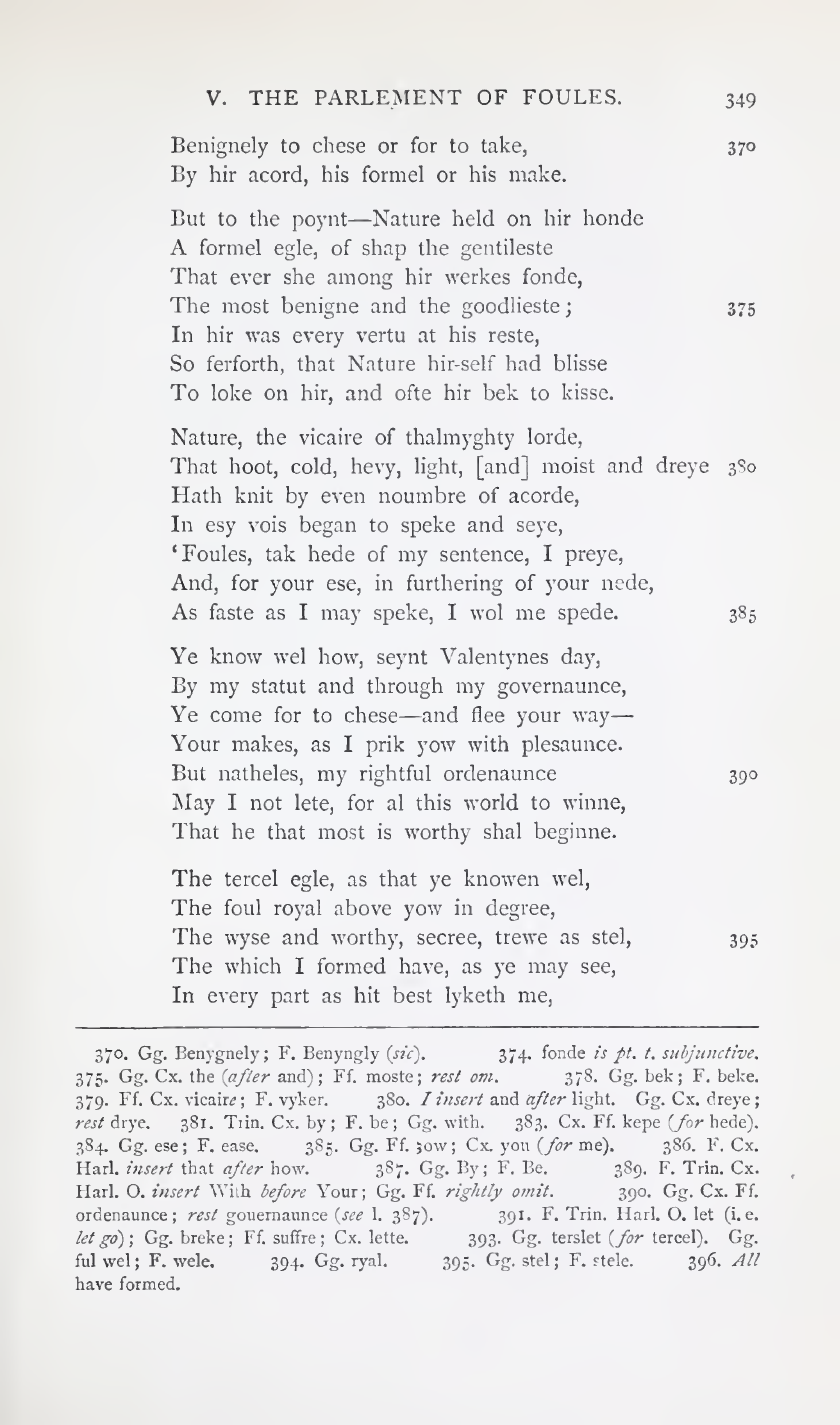
Parlement of Fouleslines 309–315, 330–343, 370–397

Whan every foul cometh ther to chese his make,Of every kinde, that men thenke may;Ther mighte men the royal egle finde,That with his sharpe look perceth the sonne;Ther was the douve, with hir eyen meke;A formel egle, of shap the gentileste …The tercel egle … The foul royal above yow in degree.

Chaucer supplies the avian grammar: kinds of bird, mate choice, eagle, dove, female formel, male tercel. Donne moves the courtship system inside the lovers.

View public source Skeat, vol. 1, p. 349
shakespearestrong

The Phoenix and Turtlestanzas 5–13

Love and constancy is dead,Phoenix and the turtle fledIn a mutual flame from hence.
So they loved, as love in twainHad the essence but in one,Two distincts, division none;Number there in love was slain.
How true a twainSeemeth this concordant one!

The decisive cluster is eagle + phoenix + dove/turtle + mutual flame + two distinct lovers becoming one. Donne makes the paradox grammatical: both sexes fit one neutral thing.

View public source Folger Shakespeare
SourceShared operationDonne’s transformation

formel · tercel · make

sexed pairing

both sexes fit

eagle · dove

avian identities

in us finde

two distincts, division none

one from two

we two being one

mutual flame

death / renewal

tapers · die and rise

Walter Skeat’s edition of Chaucer’s Parlement of Foules, page 349, showing the female formel eagle, male tercel eagle, and Nature’s mate-choice ordinance.
Primary-page control

Sex and species under Nature: formel, tercel, mate choice, and the royal eagle.

Open the public scan

Stanza 4 of 5

Build the little room

Denied tomb, hearse, legend, and chronicle, the lovers invent a smaller afterlife: sonnet, urn, hymn, canonization.

ashes and urnmonument and verbal recordfuture canonization
John DonnePoems, 1633
  1. 28Wee can dye by it, if not live by love,
  2. 29And if unfit for tombes and hearse
  3. 30Our legends bee, it will be fit for verse;
  4. 31And if no peece of Chronicle wee prove,
  5. 32We’ll build in sonnets pretty roomes;
  6. 33As well a well wrought urne becomes
  7. 34The greatest ashes, as halfe-acre tombes,
  8. 35And by these hymnes, all shall approve
  9. 36Us Canoniz’d for Love.
Read the 1633 text
chaucerstrong

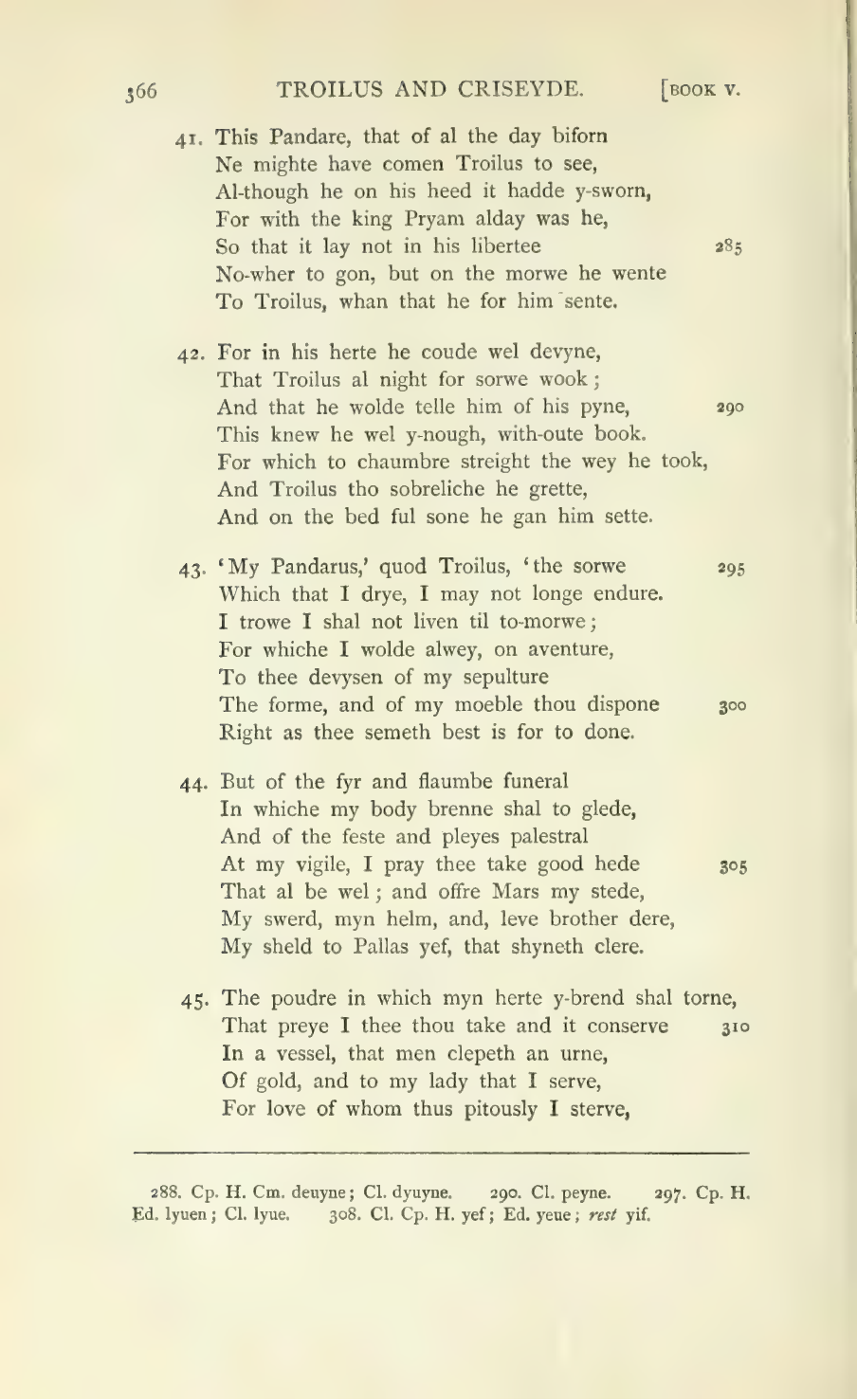
Troilus and CriseydeV.309–315

The poudre in which myn herte y-brend shal torne,That preye I thee thou take and it conserveIn a vessel, that men clepeth an urne.Of gold, and to my lady that I serve.For love of whom thus pitously I sterve,So yeve it hir, and do me this plesaunce,To preye hir kepe it for a remembraunce.

The material chain is exacting: lover → funeral flame → heart reduced to powder → precious urn → beloved → remembrance.

View public source Skeat, vol. 2, p. 367
shakespearestrong

Henry V1.2

KING HENRYOr lay these bones in an unworthy urn,Tombless, with no remembrance over them.Either our history shall with full mouthSpeak freely of our acts, or else our grave,Like Turkish mute, shall have a tongueless mouth,Not worshiped with a waxen epitaph.

The same memorial decision: urn, tomb, grave, history, remembrance, epitaph. The 1600 quarto already prints the chronicle / acts / epitaph structure, so the Folio wording does not force a 1623 date.

View public source Folger Shakespeare
shakespearestrong

Troilus and Cressida2.2

TROILUSShe is a theme of honor and renown,A spur to valiant and magnanimous deeds,Whose present courage may beat down our foes,And fame in time to come canonize us;

Shakespeare’s future fame canonizes warriors; Donne’s future hymns canonize private lovers. The syntax survives while the value system reverses.

View public source Folger Shakespeare
shakespearestrong

Sonnet 55lines 1–4, 9–14

Not marble nor the gilded monumentsOf princes shall outlive this powerful rhyme,But you shall shine more bright in these contentsThan unswept stone besmeared with sluttish time.
Your praise shall still find roomYou live in this, and dwell in lovers’ eyes.

Rhyme outlives marble; praise finds room; the beloved dwells in eyes. Donne’s ‘pretty roomes’ compress the same anti-monumental promise.

View public source Folger Shakespeare
SourceShared operationDonne’s transformation

heart burnt to powder

body compressed

greatest ashes

gold urn / unworthy urn

container

well wrought urne

history’s full mouth

public memory

no peece of Chronicle

fame canonize us

future status

Canoniz’d for Love

Walter Skeat’s edition of Chaucer’s Troilus and Criseyde, page 366, showing Troilus planning his funeral flame and the preservation of his burned heart.
Primary-page control

The lover as residue: Troilus imagines his heart burned, powdered, and conserved.

Open the public scan

Stanza 5 of 5

Contract the world

The lyric scripts its own reception: future lovers invoke these saints whose reciprocal eyes epitomize countries, towns, and courts.

eyes, windows, mirrorsworld compressedfuture pattern
John DonnePoems, 1633
  1. 37And thus invoke us; You whom reverend love
  2. 38Made one anothers hermitage;
  3. 39You, to whom love was peace, that now is rage,
  4. 40Who did the whole worlds soule contract, and drove
  5. 41Into the glasses of your eyes
  6. 42So made such mirrors, and such spies,
  7. 43That they did all to you epitomize,
  8. 44Countries, Townes, Courts: Beg from above
  9. 45A patterne of our love.
Read the 1633 text
shakespearemoderate

Sonnet 24lines 1–12

Mine eye hath played the painter and hath stelledThy beauty’s form in table of my heart;My body is the frame wherein ’tis held,And perspective it is best painter’s art.Mine eyes have drawn thy shape, and thine for meAre windows to my breast, wherethrough the sunDelights to peep, to gaze therein on thee.

A reciprocal optical system—image, frame, glazing, window, drawing, sight. Donne expands it from the beloved’s shape to the world’s political geography.

View public source Folger Shakespeare
Word historycontextual

Samuel Bird1598

“to Epitomise and to anatomise these two chapters:and as it were in a glasse first generallyto set them before thine eyes

Before 1600, epitomising already sits beside anatomy, glass, and eyes. The semantic field is available; this is context, not a claim that Donne copied Bird.

View public source EarlyPrint A16164
Word historycontextual

Johann OberndorfEnglish translation, 1602

“in whose Bodie, whatsoeuer is more largelyin that Spatious, and Gorgious Pallace, and Theaterdelineated, is more briefly comptised,and as it were Epitomised, and representeda short Summe or Viewe.”

The greater world appears in the human body as a short view. Donne’s lovers’ eyes perform a more audacious microcosmic contraction.

View public source EarlyPrint A08437
SourceShared operationDonne’s transformation

eye as painter

reciprocal optics

glasses · mirrors · spies

body as frame

microcosm

whole world’s soul

epitomise · anatomise · glass

compression

countries · towns · courts

Can the words date the poem?

Not by themselves. No content word requires a date after 1599. Click the high-signal words to see why clusters matter more than first attestations.

1564+rare cluster

plaguie

Not a late coinage. Its dating force comes from the two-node relation to Troilus and Cressida: ‘plaguy’ death-tokens here, ‘canonize us’ there.

Peak normalized EEBO bands

129 content lemmas
1473–15991
1600–0257
1603–087
1609–1457
1615–200
1621–325
1633–492

Exploratory, not a formal date estimator: period bands differ in size and genre, and words are not independent votes.

A window, not a verdict.

The source-bearing form most plausibly belongs between the 1609 Shakespeare prints and Donne’s abandoned pre-ordination print project in late 1614. Performance, manuscript access, and revision keep the boundaries permeable.

1588

Epitomize is already English

The apparently late word supplies no late terminus.

1600

Henry V, first quarto

Chronicle, full mouth, acts, and epitaph are in print.

1601

The Phoenix and Turtle

Phoenix, dove, mutual flame, two-in-one, cinders, urn.

1603

James I succeeds

The stable King’s coin image supports a Jacobean horizon.

1609

Troilus quarto + Sonnets

The strongest conservative printed-source floor.

late 1614

Donne’s “old book”

Possible upper horizon for a pre-ordination collection.

1633

First collected print

A witness to publication—not the composition date.

Leading working window1609
not a proved datelate 1614

The architecture discovered

The poem behaves like
a miniature library built to resemble an urn.

Chaucer supplies the bird parliament’s mate, sexes, eagle, dove, and the burnt lover’s heart preserved as powder. Shakespeare supplies the phoenix and turtle’s concordant one, plague death-signs, canonization by future fame, chronicle and epitaph, ashes and saint, and poetry’s victory over large tombs. Donne compresses them until source, body, lovers, world, and poem become versions of the same question:

How can a small form
contain a great value?
Return to the first line